Life Science Insights: Why Trust Is One of the Most Important Factors in Fundraising
Fundraising is not only about selling the biggest vision. It is about building enough trust for investors to believe that future promises can actually be delivered. When founders talk about fundraising, the conversation often starts with ambition. How big is the market? How strong is the technology? How far can the company scale? How compelling is the vision? All of that matters. Founders need to sell the company. They need to make investors understand why the opportunity is worth their time, attention, and capital. But ambition is not the full story. Especially in life sciences, fundraising depends on trust.


Trust Comes Before the Term Sheet
The first investor conversation rarely gives investors a complete understanding of the company. In life sciences and other deep tech sectors, no investor can understand every layer of the technology immediately. Due diligence will follow, and the details will be tested later.
That means the early fundraising conversation has another job. It needs to create enough confidence for the investor to continue. The investor may not yet understand every technical detail, but they need to trust the founder, the team, and the way the company communicates what it knows and what it still needs to prove.
That trust can be the difference between a conversation that endspolitely and one that moves toward a second meeting, deeper diligence, andeventually a term sheet.
Transparency Builds More Confidence Than Perfection
Founders often feel pressure to present the strongest possible version of the company. That is understandable. Fundraising is competitive, and investors see many companies that are all trying to look convincing.
But trying to hide weaknesses can create the opposite effect. No one can ever understand the technology to the deepest layer. When weaknesses are hidden for too long, the investor does not feel more confident. They feel less sure that they have the full picture.
Transparency changes that dynamic. When founders are extremely transparent about weaknesses and strengths from the start, investors have the feeling that they have a clear picture. That does not weaken the story. It can make the story more credible.
Due diligence will test the claims anyway. Founders who communicate openly before that process begins give investors a reason to trust not only the opportunity, but also the way the team handles risk.
Think Narrow and Deliver
One of the most useful fundraising lessons is also one of the simplest: think narrow and deliver on your promises.
Founders do not need to prove everything at once. In fact, broad promises can make the company harder to believe. A narrow promise gives investors something concrete to evaluate. It shows that the team understands what matters next, what needs to be de-risked, and what evidence will move the company forward.
When the team delivers on that narrow promise, it creates credibility. That credibility then supports the next promise. Over time, this is how investor trust compounds.
This matters because investors cannot evaluate the future directly.They have to look at the past. They look at whether the team did what it said it would do. They look at whether the company communicated clearly. They look at whether previous milestones were delivered with discipline.
Past Credibility Makes Future Promises Believable
Every fundraising process asks investors to believe something about the future. The company will deliver on its promises. The team will de-risk and move forward.
But the future has no proof yet. The only evidence investors can use is the credibility founders have already built.
That is why consistency matters so much. A founder who has been transparent about weaknesses, precise about milestones, and disciplined in delivery gives investors a reason to believe the next step. The promise is not credible because it sounds ambitious. It is credible because the team has shown that it can deliver on the promises it makes.
For founders raising investment, this shifts the focus. The goal is not to create the biggest possible story. The goal is to make the next milestone believable, show that the company can de-risk it, and give investors confidence that future promises are grounded in past behavior.
Key Takeaways for Founders
Trust is a fundraising asset.
Ambition matters, but trust is what carries investors from the first conversation to deeper diligence and, eventually, a possible term sheet.
Transparency creates credibility.
Being extremely transparent about weaknesses and strengths gives investors a clear picture and the feeling that they have a clear view of the company.
Narrow promises are easier to believe.
Founders do not need to prove everything at once. A focused promise that is delivered well builds more trust than a broad promise that remains abstract.
Past delivery supports future promises.
Investors have no other way to evaluate the future except by looking at past credibility and track record.
Fundraising is not only about selling the company.
It is about helping investors trust that the team can de-risk the next stage and deliver on what it says it will deliver.
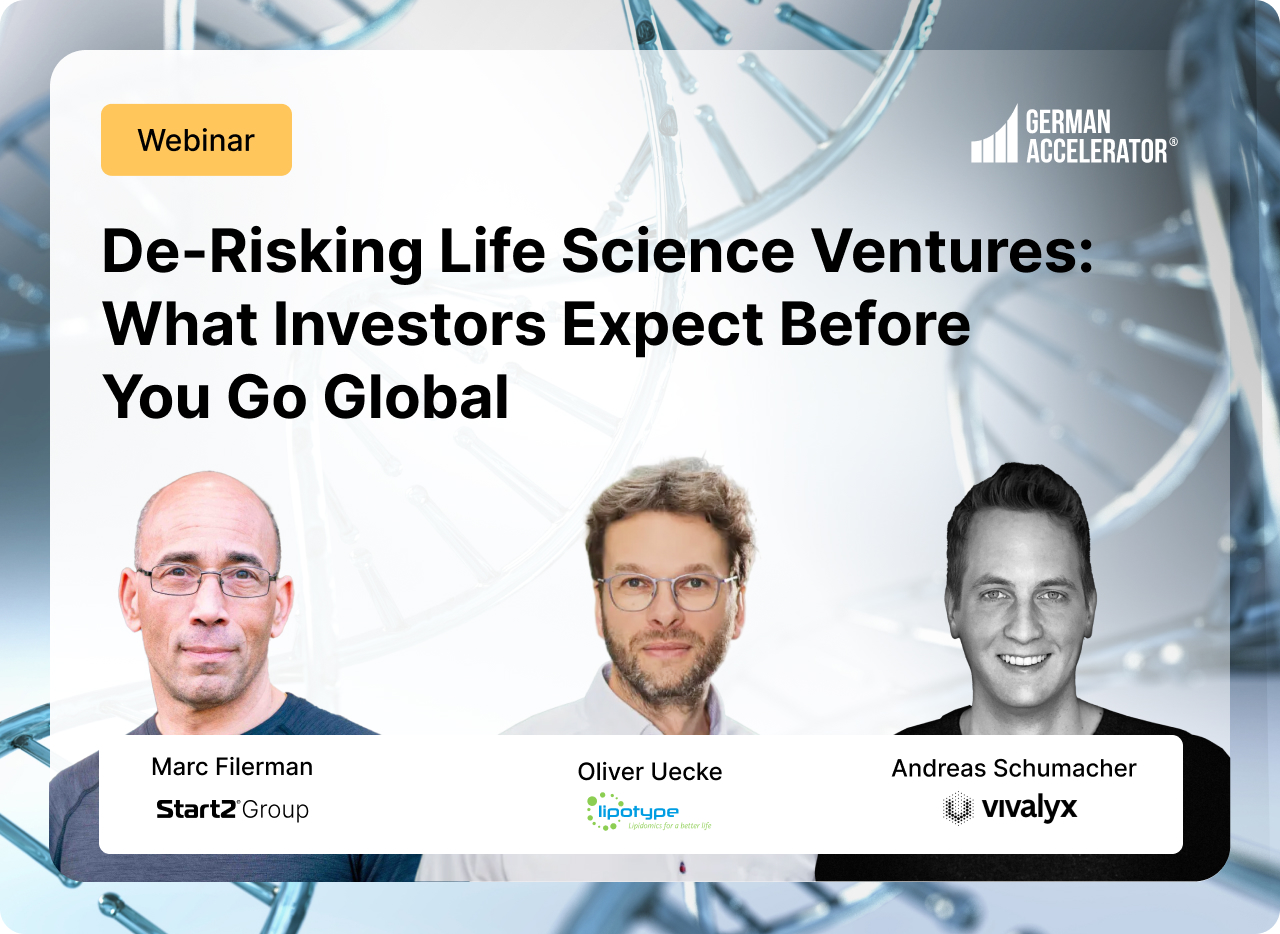
This article is based on insights shared during our webinar, “De-Risking Life Science Ventures: What Investors Expect Before You Go Global”, featuring
- Marc Filerman, CBO The Americas, Start2 Group
- Andreas Schumacher, CEO & Co-Founder of Vivalyx
- Oliver Uecke, COO Lipotype GmbH and CEO Lipotype Inc.