From Founder to Ecosystem Architect: How One Exit Shaped a New Vision for Europe’s Deep Tech Future Copy
Marius knows the ups and downs of entrepreneurship. He has personally gone through the unavoidable cycle of: build break, rebuild and scale - and ultimately he managed to sell his life cycle company. Today, he refers to himself as an “ecosystem architect,” a role that blends entrepreneurship, investing, mentorship, program design, and a candid realism about what it takes to build and scale globally relevant companies out of Europe.


What makes his story compelling is not just the exit. It’s the way he has dissected the founder journey, the psychology, the pressures, the timelines, the investor dynamics, and transformed those lessons into guidance for the next generation of startups shaping Europe’s most complex industries.
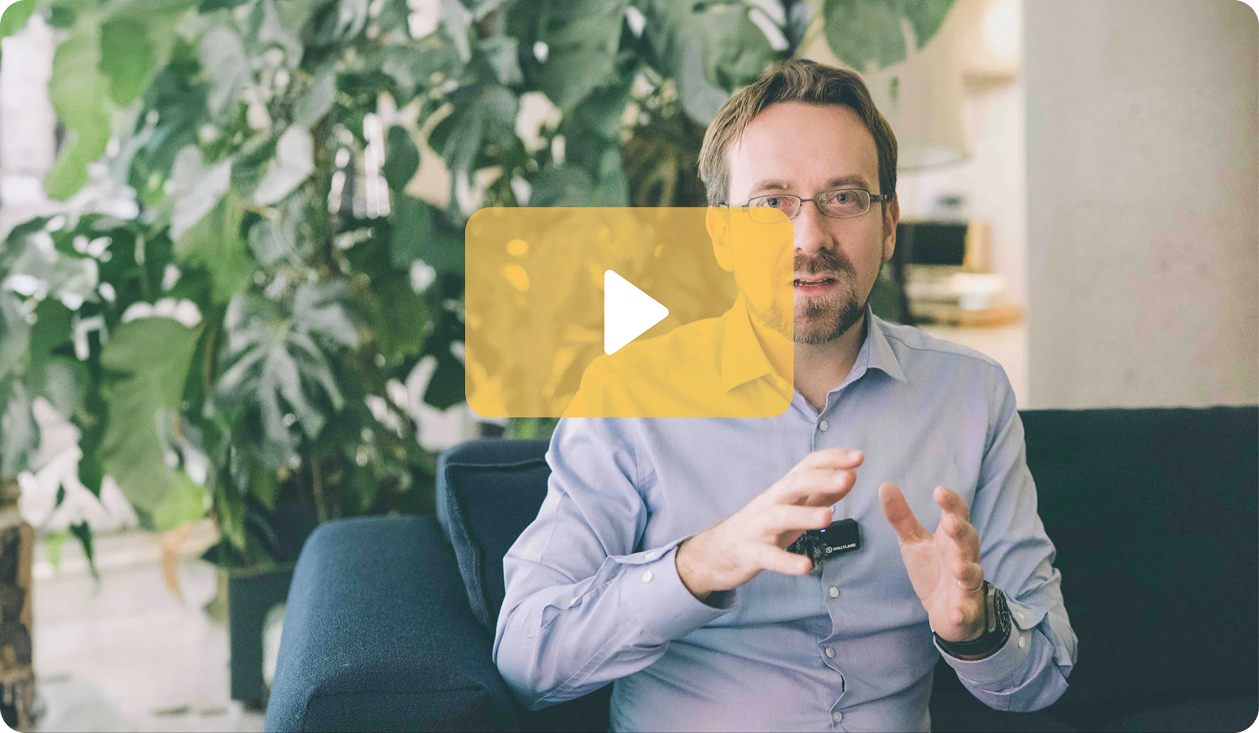
Click the play button to watch the video.
A Founder Who Became an Ecosystem Architect
“My name is Marius. I’m a life science entrepreneur,” he says without hesitation. “I started a medical device company, and I’ve become an ecosystem architect. I help other founders build their companies and push the German and European startup ecosystem forward. ”Today, that work spans designing programs like German Accelerator, Gateway Factory and Scale-Up NRW, shaping curriculum, coaching founders, bringing in industry mentors, and leveraging his network to strengthen the deep tech pipeline. It’s an unusual combination: operator, investor, educator, lecturer, father. But the identity that shaped him above all?“ Being a founder changed everything. Starting a company from scratch at 28, that experience still defines how I work, how I decide, and how I understand what founders go through.”
The Moment Everything Shifted
For many founders, there’s one moment when they realize: This might actually work. For Marius, it happened in Houston, Texas, in a meeting that almost didn’t happen. “ We were trying to raise our second round with U.S. investors. We got a meeting with the head of the Texas Medical Center, the largest hospital complex in the world. We waited one and a half hours because he didn’t show up. When he finally arrived, he said: ‘Okay, what do you want?’” They showed him a video of their product. His reaction? “One word: ‘Wow.’” That moment led to an hour-and-a-half conversation, multiple follow-up visits, introductions to surgeons and decision-makers, and eventually one of the company’s strongest medical advocates. “That was the day I realized: if he says wow, then what we’re building really is big.”
The Business Plan Competition That Changed Everything
The journey to the U.S. wasn’t strategic, it was accidental. The team had participated in global business plan competitions to gather expert feedback. They ended up in Brazil for the Idea2Product finals and walked away empty-handed. But one juror told them: “You’re too advanced for this. Go to the Rice Business Plan Competition in Houston.” They did. They won, becoming the first non-U.S. team ever to do so. “That competition changed everything. It opened the U.S. for us, investors, surgeons, networks, credibility. It was never our plan to raise there. But the doors opened, and the timing was right.”
The Exit: When All the Stars Align
After years of development, fundraising, certifications, and early product success, the company exited in 2017. “An exit is like a lunar eclipse,” he says. “Multiple stars have to align. A buyer must be ready. Your shareholders must be willing to sell. And the global economic situation must be favorable. There’s a lot of luck involved. ”But it wasn’t only luck.They had spent years opening doors, nurturing relationships, and preparing for the moment. In life sciences, the timing is even more complex. “Most life science companies are one-product companies, you’re a one-trick pony. Building your own sales organization is extremely risky. So exits often happen right when your first regulatory approvals are in place, before scaling commercial operations. That’s where we were.”
How an Exit Changes the Way You Invest
After selling the company, the biggest realization was humility. “Many founders fall into the trap of thinking: I’ve done it once; I can do it again. But repeating an exit is extremely hard. It’s rare. So as an investor, I never take success for granted.” The exit also gave him a perspective that few people ever get. “Being a founder who has gone through an exit is like being part of a country club you cannot buy your way into,” he says. “You only get there by earning it, by going through the grind, the uncertainty, the pressure, and still finding a path to the finish line.” It’s a small club, he explains, much smaller than people assume. “Globally, maybe only a few thousand people have actually done this. And it gives you insights into how the process really works, insights you can’t get from books, board seats, or watching M&A transactions from the sidelines.” That shapes how he evaluates teams today. “When I invest, I ask: can this team build a company and go through an exit? Those are two very different skills. Very few founders can do both.” It also shapes how he reads founder psychology, pressure, resilience, and how he supports teams during make-or-break moments.
The “Whatever-It-Takes” Mentality
When evaluating founders, he looks for one trait above all: “A whatever-it-takes mentality.” This isn’t romantic hustle culture. It’s a cold truth of early-stage building. “Nine out of ten startups fail. But unlike roulette, where you cannot change the odds, in founding you can. You can influence the likelihood of being the one that survives, but only if you put the company first, relentlessly, for a defined period of time. Sometimes that means saying yes to impossible requests. If an investor calls and says, ‘Can we meet tomorrow in San Francisco?’ the answer is: ‘Yes, I’ll be there.’ That’s what it takes.” But this mindset comes with personal consequences, on family, relationships, and mental health. “You have to make a deal with your partner. It’s a specific phase where the company needs to come first. And you need co-founders.”
Navigating the Human Cost and the VC Clock
Marius is acutely aware of the personal cost of this commitment. He stresses that the "whatever-it-takes" phase must be treated as a “confined time zone” a certain number of years, during which expectations must be clearly managed with family and surroundings. His personal experience as a father proved the critical need for a supportive team: "My two kids were born during that time. And so, of course, I tried to work a little bit less during that time. And then my co-founder stepped up, which I’m forever thankful for.” He strongly advises against being a “lone wolf,” which he says “will kill you at some point.” A strong team is essential for mental health and sustainability.
What Founders Misunderstand About Investors
According to Marius, the biggest misconception is that all investors behave the same. “They don’t. Angel investors spend their own money. Venture capitalists invest other people’s money. That changes everything.” Angels invest from enthusiasm and personal conviction. VCs invest from portfolio logic, timelines, and fund cycles. A founder must understand this dynamic — and especially the fund lifecycle. “If a fund is already four or five years in, your timeline shrinks. They’ll eventually pressure you to sell because they must return money to their LPs. You cannot change this. You can only be aware.”
Why Europe Is Uniquely Positioned for the Deep Tech Wave
Despite Europe still investing far less than the U.S. relative to GDP, he sees Europe uniquely suited for the next era of innovation. “When I started in 2012, doing life science was weird. Everyone was building internet companies. But the waves of entrepreneurship evolve. First B2C. Then SaaS. Now deep tech.” This is not a hype cycle, he argues, it’s maturity. “We’re tackling bigger problems: climate, energy, aerospace, life sciences, defense. You can’t solve climate change with software alone. You need hardware. Europe is strong in hardware.” Universities like TUM, RWTH Aachen, ETH Zurich, TU Berlin and others are becoming hubs of specialized clusters. He believes Europe’s multi-center system, often seen as a disadvantage is actually an asset. “People can choose where to live. Clusters can mature on their own strengths. Talent spreads. And investors now screen globally, so location matters far less than it used to.”
The Future of European Investing
His biggest concern? Europe is underinvesting in innovation. “Measured per capita or relative to GDP, the U.S. invests four to five times more in startups than Europe does. That’s a problem. Europe is aging, and we rely on a heavy social system. The only way to sustain it is through innovation.”The investments made today will only pay off a decade or two from now.“If we don’t accelerate now, we fall behind for good.”
From Founder to Ecosystem Architect
Today, as Chief Program Officer at Start2 Group and Deputy Program Director at Scaleup.NRW, Marius uses his experience to design startup programs that prepare founders for real-world growth, from investor readiness to mental resilience. “I see my role as building bridges,” he says. “Between founders and investors. Between ambition and sustainability. Between ideas and execution.” It’s a rare vantage point: part builder, part mentor, part architect. But at its core, Marius’s journey carries one throughline: empathy for the people behind the pitch decks. “Founding is hard,” he says. “Investing is hard. But if we keep learning from each other, we can build an ecosystem that makes it a little easier, and a lot more meaningful.” “I like to help founders. I love technology. I want to push the ecosystem forward. And I learn from every company I invest in.” Every startup becomes another micro-MBA. Every founder journey provides another data point. Every exit teaches another lesson. And the ecosystem is stronger for it.